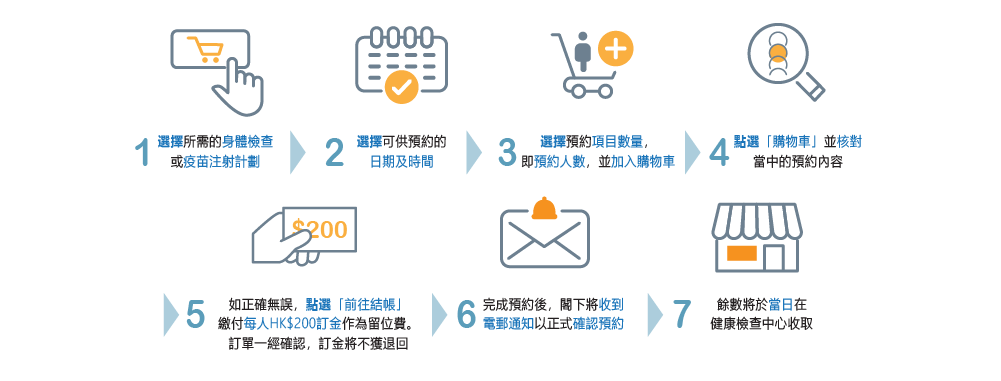
📃Report: Results available within 7-10 working days
👩🏼🔧Result explained by doctor / healthcare professionals
Test Includes:
Doctor’s personalised consultation before check-up
Blood Pressure, Height, Weight & Body Mass Index
Haemoglobin A1c (HbA1c)
Insulin Resistance (HOMA1-IR)
Cholesterol, Total
Cholesterol, HDL
Cholesterol, LDL (Indirect)
VLDL Cholesterol
Total/HDL Ratio
Triglycerides
Alkaline Phosphatase
ALT (SGPT)
AST (SGOT)
Bilirubin, Total, Direct & Indirect
Gamma Glutamyl Transferase
Protein, Total
Uric Acid
Fibroscan
Medical report with doctor’s comments and explanation
*In case of any dispute, Health Gene Limited reserves the right to make the final decision.*
The Metabolic Crisis Is Getting Younger – When “Invisible Metabolic Damage” Becomes Hong Kong’s New Normal, Is Your Health Check Far-Sighted Enough?
More and more young Hongkongers are seeing red flags on their lab reports—fatty liver, elevated uric acid, borderline HbA1c—yet their outward appearance shows little sign of obesity. Data from the University of Hong Kong reveals that 22% of Hong Kong adults are overweight, while the obesity rate stands at 32.6%[1]. The Hong Kong Association for the Study of Obesity’s 2025 survey further indicates that approximately 30% of the adult population is obese and 20% is overweight—meaning over half of Hong Kong’s adult population faces weight-related health issues[2].
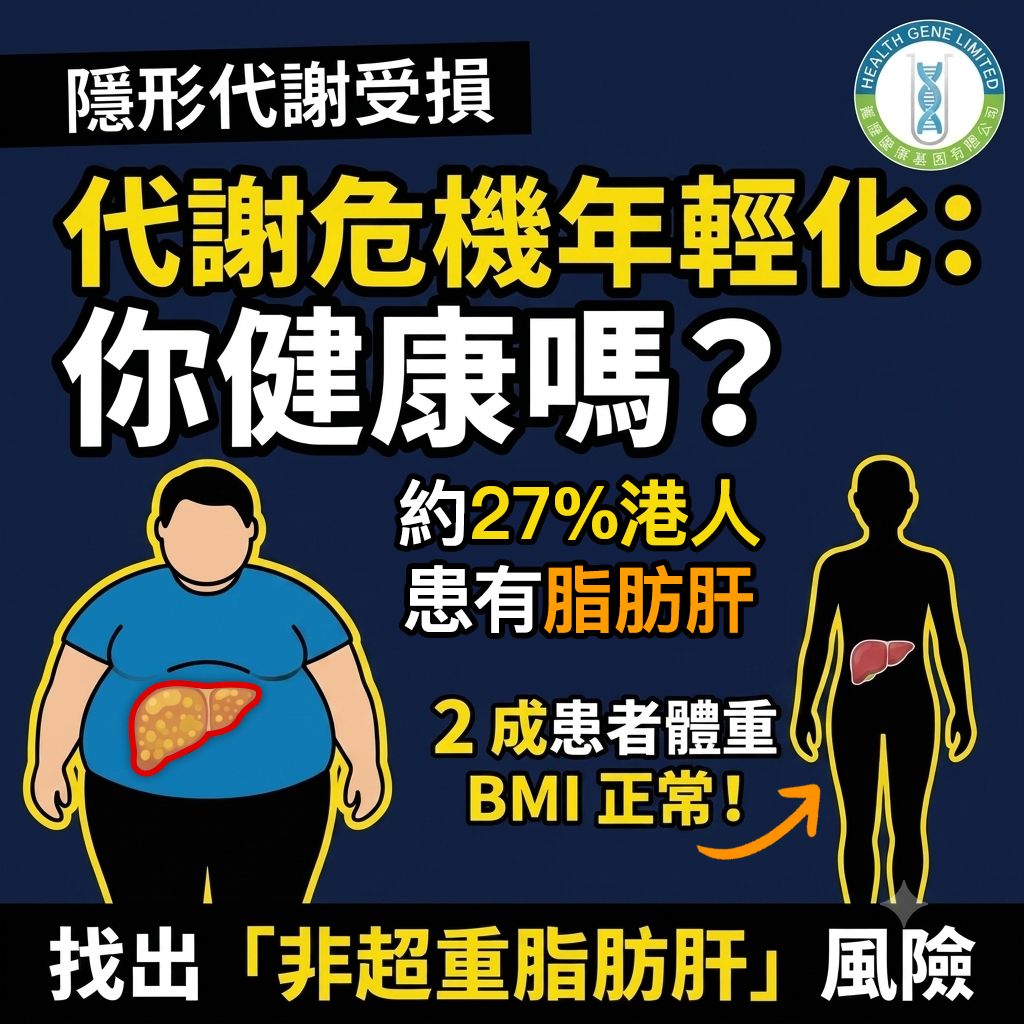
More alarmingly, the population of “metabolically unhealthy but normal-weight” individuals is expanding rapidly. They are night owls, reliant on takeout, sedentary; they have low muscle mass and excess visceral fat, yet their slim figures lull them into a false sense of safety. Research from the Chinese University of Hong Kong shows that approximately 27% of Hong Kong adults have fatty liver, and 20% of these patients have a BMI within the normal range—a condition medically termed “non-obese fatty liver”. The HKU Faculty of Medicine further notes that 30% to 40% of Hong Kong residents have metabolic fatty liver, with the proportion rising to 65% to 80% among obese individuals or those with diabetes. In other words, one in four Hong Kong adults is affected by fatty liver.
Health awareness has moved beyond mere “weight loss” toward “metabolic restoration.” Insulin resistance, visceral fat grading, and chronic inflammatory markers are now key health concerns. The critical blind spot: prediabetes, early-stage fatty liver, and hyperuricemia are often completely asymptomatic. A study covering nearly 47,000 participants in Hong Kong’s Chronic Disease Co-Care Pilot Scheme found that the prevalence of previously undiagnosed prediabetes reached 17.9%, type 2 diabetes 6.0%, and hypertension 14.7%—behind these numbers lie countless undetected metabolic warnings.
Screening should not stop at “disease versus no disease”; it must interpret the body’s “metabolic early warnings” and block chronic disease a full decade in advance.
We strongly recommend that, regardless of age or body shape, the following tests be included in your annual health checkup core panel:
– Hemoglobin A1c (HbA1c) – Reflects average blood glucose over the past 3 months, catching dysglycemia earlier than fasting glucose alone. In Hong Kong’s chronic disease screening programmes, the prediabetes detection rate has reached 17.9%[3].
–Insulin Resistance Assessment (HOMA-IR) – Quantifies insulin sensitivity precisely; the gold-standard prediabetes marker. Research confirms that insulin resistance is a characteristic feature of Hong Kong Chinese patients with metabolic syndrome[4].
– Complete Lipid Panel (Total cholesterol, triglycerides, HDL, LDL) – Evaluates atherosclerosis risk. CUHK research has found that trunk fat percentage correlates closely with adverse lipid profiles[5].
– Uric Acid – A key metabolic syndrome biomarker. Hong Kong’s gout prevalence continues to rise; excess uric acid not only triggers gout but is closely linked to hypertension and kidney disease.
–Fibroscan – A fast, non-invasive scan used as a painless alternative to a liver biopsy. It primarily measures liver stiffness to detect tissue scarring (fibrosis) and liver fat content to diagnose and monitor fatty liver disease[6].
Metabolic Dysfunction-Associated Steatotic Liver Disease (MASLD) occurs when underlying systemic metabolic imbalances cause excess fat to accumulate within liver cells, independent of heavy alcohol consumption. Recognized as one of the most widespread chronic liver conditions worldwide, it impacts roughly 38% of the global population[7] and affects approximately one in four adults in Hong Kong[5].
Diagnostic Threshold
A clinical diagnosis of fatty liver disease is established when lipid accumulation exceeds 5% of total liver cells (hepatocytes)[8].
Symptoms
Early Stages: Predominantly silent and asymptomatic, making it difficult to detect without routine objective screening[8].
Progression Phase (Steatohepatitis): As liver inflammation develops, subtle and non-specific signs—such as persistent fatigue or reduced appetite—may surface.
Advanced Stages (Cirrhosis / Liver Cancer): Prominent symptoms like jaundice (yellowing of the skin and eyes) or ascites (fluid retention in the abdomen) typically emerge only after irreversible structural damage or liver cancer has developed[8,9].
🎯Causes
Visceral Fat Accumulation: Excess internal abdominal fat remains the primary driver of hepatic fat storage[9].
Dietary & Daily Habits: Sustained caloric surplus, diets rich in refined sugars, sodium, and saturated fats, coupled with a sedentary lifestyle.
Secondary Factors: Rapid, aggressive weight loss (crash dieting) or prolonged corticosteroid therapy (representing a smaller subset of cases)[8].
Gouty Arthritis
What is Gout? Gout is a type of arthritis caused by excess uric acid in the blood, leading to sharp urate crystals forming in the joints—triggering sudden and severe attacks of pain and swelling.
Common Signs:
Sudden, intense joint pain (often at night)
Most often affects the big toe, but also knees, ankles, fingers
Redness, swelling, and warmth at the joint
Recurrent attacks if left untreated
Chronic cases may lead to tophi (uric acid crystal lumps)




 Diagnostic Threshold
 Symptoms
 Early Stages: Predominantly silent and asymptomatic, making it difficult to detect without routine objective screening[8].
 Progression Phase (Steatohepatitis): As liver inflammation develops, subtle and non-specific signs—such as persistent fatigue or reduced appetite—may surface.
 Advanced Stages (Cirrhosis / Liver Cancer): Prominent symptoms like jaundice (yellowing of the skin and eyes) or ascites (fluid retention in the abdomen) typically emerge only after irreversible structural damage or liver cancer has developed[8,9].
 Most often affects the big toe, but also knees, ankles, fingers
 Recurrent attacks if left untreated
 Chronic cases may lead to tophi (uric acid crystal lumps)
 According to